
Takao Tanabe
A Canadian Legend at 100
Story by Katherine Fawcett
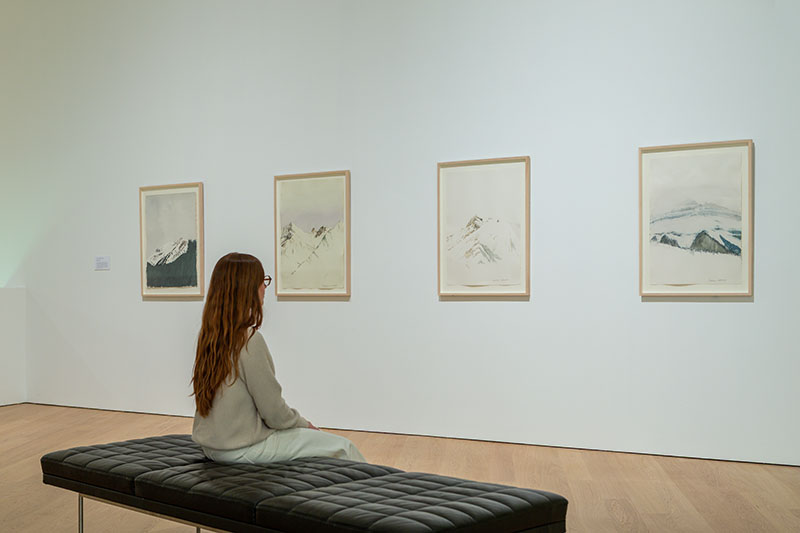
Installation View Photo: Joern Rohde
Turning 100 is extraordinary on its own. Doing so while recognized as one of Canada’s most respected living artists feels even more remarkable. For Kiriko Watanabe, the AAM’s Gail & Stephen A. Jarislowsky Chief Curator, the timing made the exhibition impossible to pass up.
“Tak is one of the most important Canadian artists alive, period,” she said. “He himself is a living treasure.”
Born in 1926 in the Japanese Canadian fishing community of Seal Cove in Prince Rupert, B.C., Tanabe’s early life was shaped by hardship and displacement. During World War II, he and his family were forcibly interned at Lemon Creek, B.C., after the Canadian government removed thousands of Japanese Canadians from their homes on B.C.’s coast. The experience cut short his formal education and deeply influenced his understanding of identity, resilience, and place.
After the war, Tanabe moved to Winnipeg, where he discovered art almost by accident while looking for practical job skills. He enrolled at the Winnipeg School of Art and quickly stood out as an exceptional talent. Encouraged by B.C. painter Joseph Plaskett, Tanabe left commercial sign painting behind and committed himself fully to fine art, a decision that would eventually help reshape Canadian landscape painting.
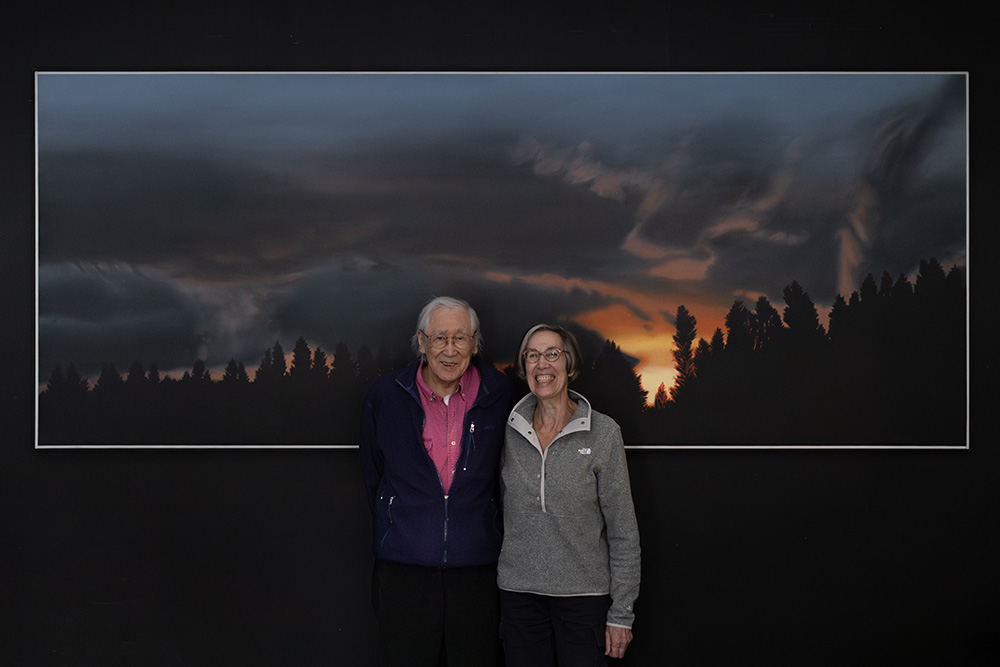
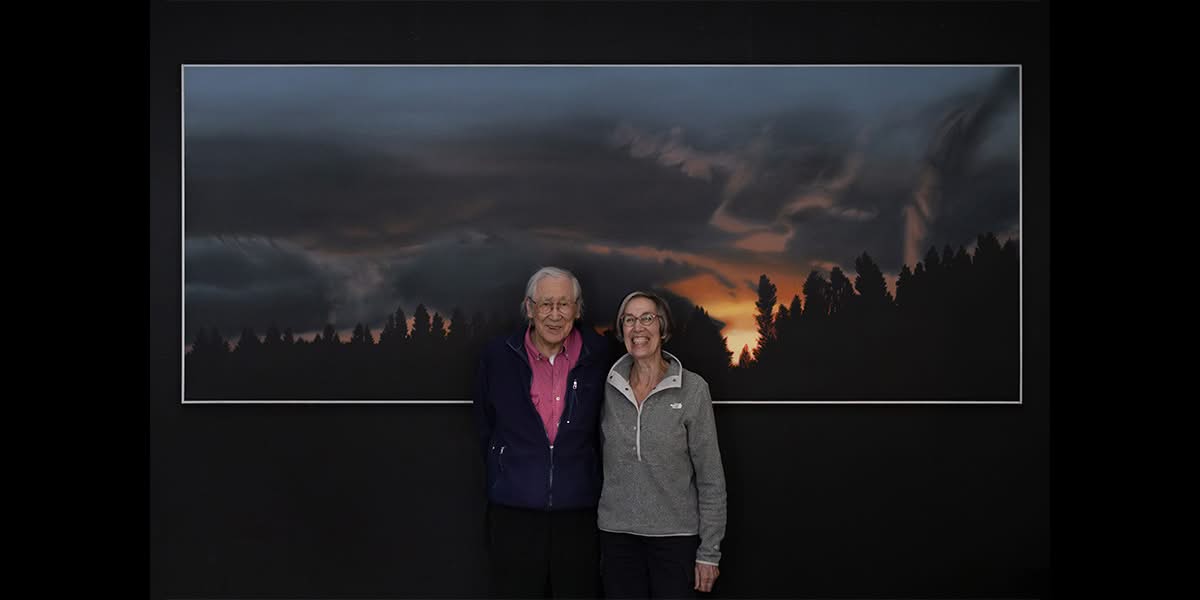
Takao Tanabe and Anona Thorne in front of Tanabe’s painting Errington Sunset (2010-11). Photo: Kyle Graham, 2015.
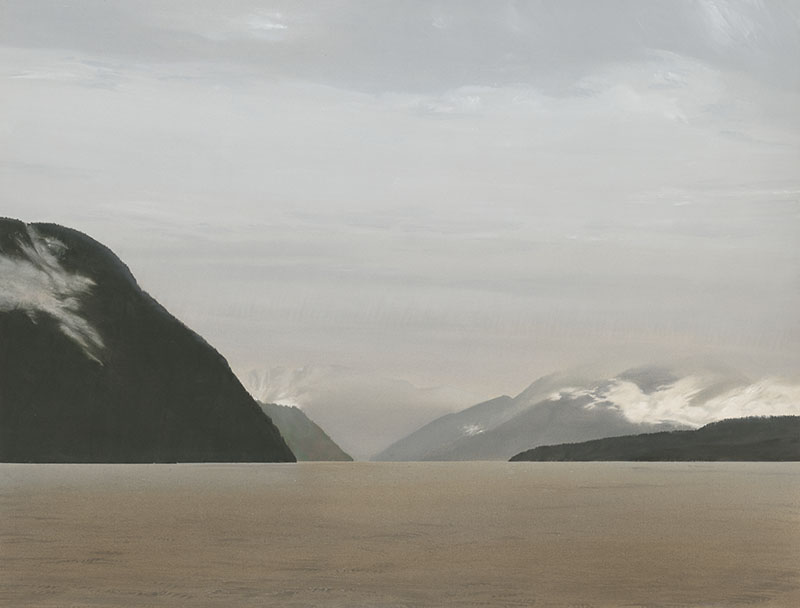
Takao Tanabe, Strait of Georgia 1/90: Raza Pass, 1990,
acrylic on canvas, 142.2 x 186 cm. Audain Art Museum Collection.
Gift of Michael Audain and Yoshiko Karasawa. © Takao Tanabe.
Photo courtesy of the Audain Art Museum.
Over the decades that followed, Tanabe travelled widely through Europe and Japan, to New York, and across Canada, drawing inspiration from everything from abstract expressionism to Japanese calligraphy and sumi-e (a traditional form of ink wash) painting. Yet despite the many changes in his style, from bold abstracts to quiet coastal landscapes, his work has always been rooted in a deep sensitivity to space, weather, silence, and light.
Watanabe, who began planning the Audain exhibitions almost three years ago, originally imagined them as a broader exhibition celebrating B.C. art; the project evolved into a major Tanabe retrospective once she realized the museum’s 10th anniversary would coincide with the artist’s centennial year.
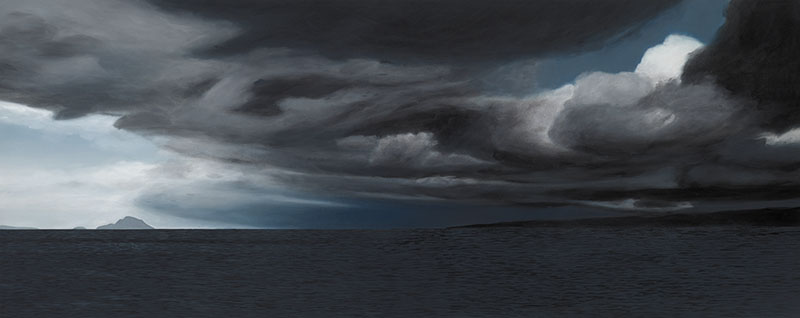
Takao Tanabe, Storm, 2014, acrylic on canvas, 121.9 x 304.8 cm.
Audain Art Museum Collection. Gift of Michael Audain and Yoshiko Karasawa.
© Takao Tanabe. Photo courtesy of the Audain Art Museum.
Created in collaboration with the National Gallery of Canada and the Art Gallery of Greater Victoria, Takao Tanabe 100: Inside Passage runs until Oct. 19 and includes more than 50 paintings dating from the 1950s to 2010s. While many viewers know Tanabe for his misty coastlines and sweeping prairie horizons, this exhibition reveals a much broader and more experimental side of his work.
Alongside the meditative grey skies and calm waters for which he is best known, visitors will also encounter his delicate white painting series, bold modernist abstractions, brilliant hard-edged paintings, dramatic storm clouds, and works from the powerful Emperor series. Installed in reverse chronological order, the exhibition begins with large late-career coastal paintings, then guides visitors backward through earlier decades of artistic experimentation.
“This exhibition will surprise people,” Watanabe said. “People know Tanabe’s quiet coastal paintings, but here they'll discover entirely different sides of his work as well.”
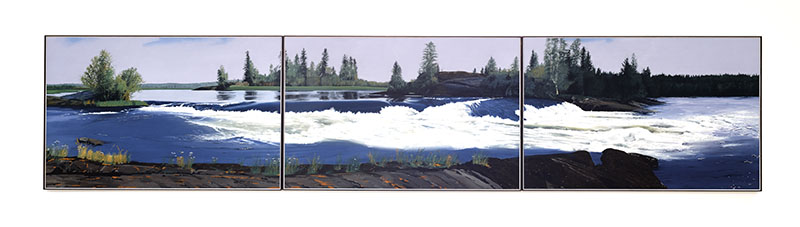
Takao Tanabe, N. W. T. 1/97: Beaulieu River, 1997,
acrylic on canvas, 121.9 x 548.6 cm.
Audain Art Museum Collection. Gift of the Artist.
Photo courtesy of the Audain Art Museum. © Takao Tanabe.
The companion exhibition, Vistas: From Takao Tanabe’s Travels in the AAM’s Upper Galleries, on display until Sept. 21, focuses on works inspired by journeys across Europe and North America, including B.C. and the Arctic. Together, the exhibitions trace the evolution of Tanabe’s visual language, from more experimental abstraction to the pared-back atmospheric landscapes for which he became internationally celebrated.
For Watanabe, one of the most emotional parts of the process was visiting Tanabe and his wife, Anona, at their Vancouver Island studio as she prepared for the exhibitions.
“Every time I unpacked one of his paintings and showed it to him, his eyes lit up,” she recalled. “He would say, ‘Oh wow, I haven’t seen that painting in so long.’”
Now, as Tanabe approaches his 100th birthday in September, these exhibitions offer more than a retrospective. They celebrate an artist whose vision, discipline, and generosity have influenced generations of Canadian artists and whose paintings continue to stop viewers in their tracks with their quiet beauty and profound power.
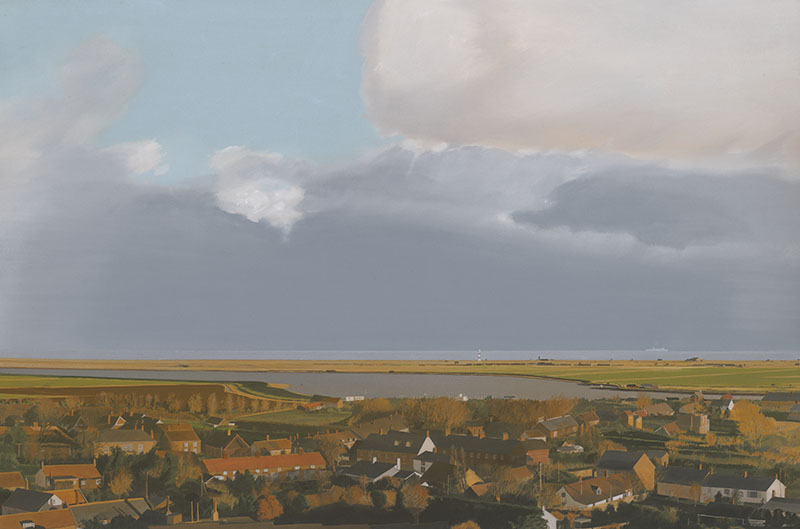
Takao Tanabe, Suffolk Village, 1996-97, acrylic on canvas, 121.9 x 183 cm. Collection of the Artist.
Photo courtesy of the Audain Art Museum.
© Takao Tanabe.
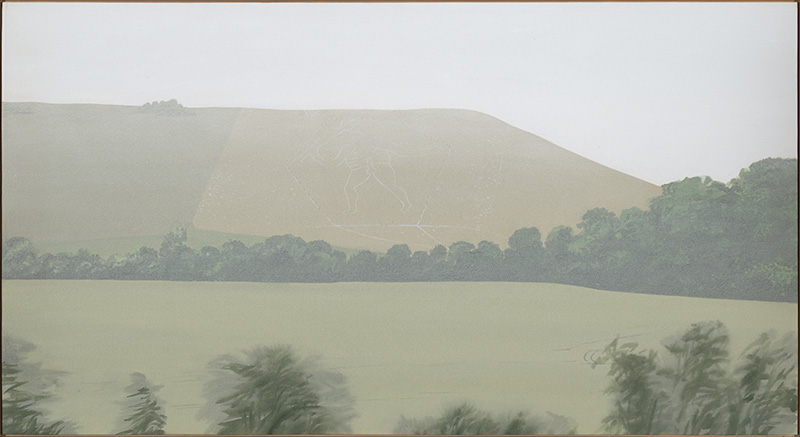
Takao Tanabe, Giant of Cerne Abbas, 2001-06,
acrylic on canvas, 76.2 x 141 cm.
Collection of the Artist.
Photo courtesy of the Audain Art Museum.
© Takao Tanabe.
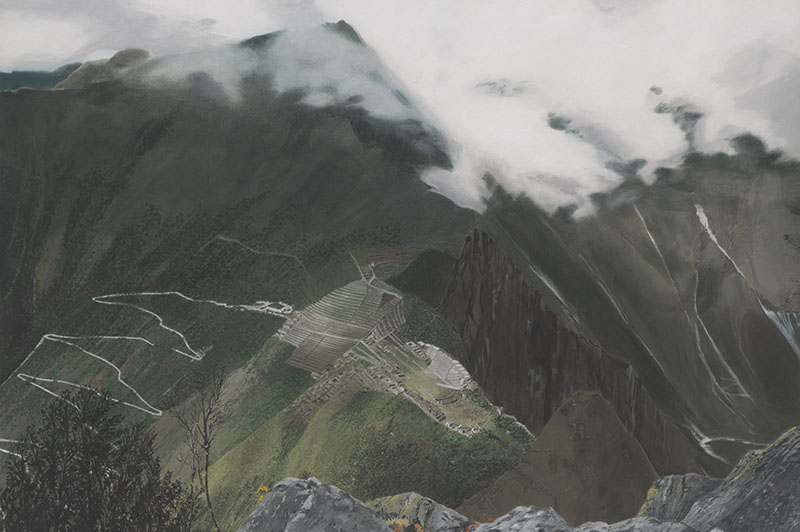
Takao Tanabe, Machu Pichu, 1990-2012, acrylic on canvas, 121.9 x 183 cm. Collection of the Artist.
Photo courtesy of the Audain Art Museum.
© Takao Tanabe.